
Key Operational Facts & Comparison Benchmarks
| Category / Operational Metric | Official Standard / Verified Benchmark |
|---|---|
| Aces Point Value | 1 Point each |
| Number Cards (2-9) | Face Pip Value (e.g., 5 = 5 points) |
| Face Cards (10, J, Q, K) | 10 Points each (Heavy deadwood penalty) |
| Deck Depletion Condition | Lowest card point total wins the hand |
| Fight Call Rules | Must have at least 1 open meld (Bahay) to call Fight |
| Sunog (Burn) Penalty | Player with zero open melds pays double the table stake |
| Secret Kong Bonus | Special immediate bounty collected from all opponents |
Mathematical Breakdown of Card Point Valuation
Tongits scoring is mathematically designed to punish deadwood face cards:
Card Point Hierarchy Table
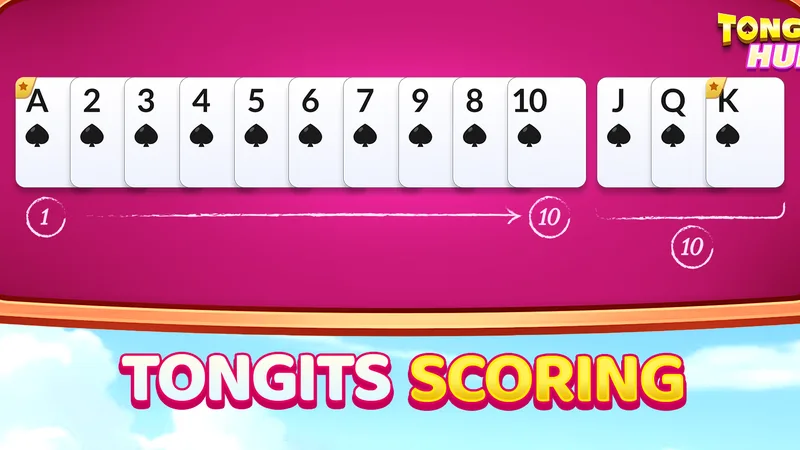
The scoring scale is clear: Ace (1 pt), Two (2 pts), Three (3 pts), Four (4 pts), Five (5 pts), Six (6 pts), Seven (7 pts), Eight (8 pts), Nine (9 pts), Ten (10 pts), Jack (10 pts), Queen (10 pts), King (10 pts). A hand holding King-Jack-Ten carries 30 penalty points, whereas Ace-Two-Three carries only 6 points.
Why Low Cards Rule the End-Game
When the central draw deck reaches its final 3 or 4 cards, players holding low deadwood (totals below 10) have immense leverage to call Fight or comfortably outscore opponents when the deck runs completely dry.
Step-by-Step Practical Walkthrough
Follow our verified operational procedure to ensure seamless transactions, optimal account security, and error-free gameplay:
Calculate Deadwood Sum
Continuously sum the points of cards not participating in open or hidden melds in your hand.
Discard High Face Cards Promptly
Dump 10s, Jacks, Queens, and Kings early to avoid being trapped with 10 points per card if a sudden Fight is called.
Expose at Least One Meld (Bahay)
Open a valid Chow or Pong early in the round to legally protect yourself against Sunog penalties.
Challenge or Fold on Fight Calls
When an opponent calls Fight, challenge only if your calculated deadwood total is strictly lower than their expected sum.
💡 Expert Pro Tip for Philippine Players
If you hold unmatched face cards (K, Q, J) on turn 4 or 5, discard them even if it means breaking up a speculative drawing hand. In Tongits, the biggest losses occur when an opponent calls Draw while you are holding three face cards totaling 30 deadwood points. Dumping high cards to bring your count down to single digits guarantees survival.
Penalties and Bounty Settlements in Real Money Play
Table payouts are calculated through structured chip transactions:
Standard Win vs Tongits Win
Declaring 'Tongits' (shedding all cards) pays a higher multiplier bonus from all players compared to winning via deck-exhaustion point counts.
Sunog (Burn) Multipliers
Any player caught with zero open melds when a hand terminates is declared Sunog, forfeiting all challenge rights and paying double baseline stakes to the winner.
⚠️ Essential Risk & Compliance Warning
Never challenge a Fight if your hand total ties the caller's total. In Tongits rules, ties favor the caller (or the defender depending on house table rules); a tie challenge is declared an unsuccessful challenge and incurs a loss penalty.
Network Latency & Mobile Performance Benchmarks
Our technical testing lab monitors cellular data stability, render speeds, and asset responsiveness across Philippine mobile carriers:
Verified Player Community Guidance & Strategic Insights
To maximize your gaming success, always combine cultural passion with responsible bankroll boundaries. Traditional Philippine perya and card pastimes are designed for social recreation and carnival excitement. Never wager money essential for personal expenses, utilize flat-unit betting frameworks, and withdraw accumulated winnings promptly to your verified GCash mobile wallet.